Key Points
- Western Sydney International (Nancy-Bird Walton) Airport officially opened for passenger operations, marking Australia’s first major airport opening in over 50 years.
- Australian Prime Minister Anthony Albanese inaugurated the $5.3 billion public infrastructure project, describing it as “Australia’s best airport, without question.”
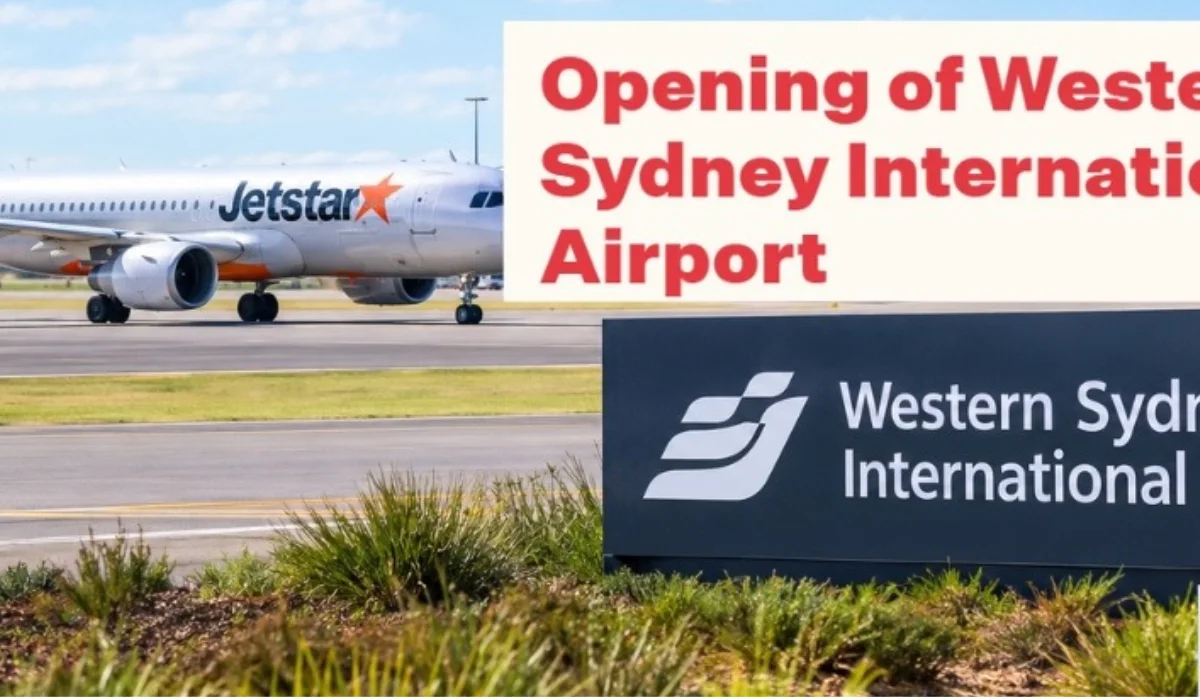
- Operations commenced with a domestic Jetstar flight to the Gold Coast, followed by the first international passenger flight operated by Air New Zealand to Auckland.
- Major carriers including Qantas, Singapore Airlines, Qatar Airways, Vietjet Air, and Fiji Airways are scheduled to launch operations from the facility.
- The curfew-free 24-hour airport features a 3.7-kilometre runway capable of landing Airbus A380s and increases Sydney’s air cargo capacity by one-third.
- The precinct incorporates sustainable infrastructure, including 9,000 solar panels and 5.5 million tonnes of recycled sandstone diverted from city tunnelling projects.
Sydney (Sydney Now Magazine) October 26, 2026 — Australia has officially opened its first major greenfield airport in more than five decades, with passenger operations commencing at Western Sydney International (Nancy-Bird Walton) Airport. Australian Prime Minister Anthony Albanese declared the $5.3 billion federal infrastructure investment open during an inaugural ceremony, highlighting its role in reshaping domestic connectivity, international trade, and regional economic growth. Designed to operate 24 hours a day without a curfew, the new gateway includes a 3.7-kilometre single runway and integrated terminal handling both domestic and international passenger streams. The facility expands Sydney’s overall air freight network capacity by one-third and forms the economic anchor for an urban region housing 2.8 million residents.
- Key Points
- How Did the Inaugural Passenger Flights and Carrier Schedules Unfold at Western Sydney International?
- In What Ways Will the New Airport Boost Trade and Expand Air Freight Capacity?
- What Economic Impact Will Western Sydney International Have on Surrounding Regions?
- What Sustainable Engineering Practices and Local Materials Were Used in Construction?
- Background of the Particular Development
- How This Development Can Affect Australian Travelers, Regional Businesses, and the Aviation Industry
How Did the Inaugural Passenger Flights and Carrier Schedules Unfold at Western Sydney International?
As reported by aviation editor Connor Kerr of Afterburner and corroborated by official opening day records, passenger services formally commenced with the departure of Jetstar flight JQ362 bound for the Gold Coast, flown by Captain Guy Proctor and First Officer Aglaya Papadokokolakis. According to details outlined by Prime Minister Anthony Albanese in his official opening address, the domestic launch is directly followed by Air New Zealand’s inaugural service connecting Western Sydney to Auckland.
As confirmed by transport correspondents covering the launch, a growing coalition of international and domestic carriers has formally committed to regular scheduled routes out of the new hub. In statements delivered during the opening ceremony, Prime Minister Anthony Albanese noted that Qantas, Singapore Airlines, Qatar Airways, Vietjet Air, and Fiji Airways will progressively integrate the airport into their global networks. As reported by local media outlets, Singapore Airlines is scheduled to commence daily non-stop services to Singapore Changi Airport, while Qatar Airways plans to introduce three weekly flights to Doha from mid-December, subject to finalizing operational arrangements.
The primary airside infrastructure centers around a 3.7-kilometre concrete runway engineered to handle Code F aircraft, including the Airbus A380. The terminal is equipped with 40 check-in kiosks, 34 automated baggage-drop facilities, and next-generation security screening technologies designed to streamline passenger processing across both domestic and international gates under a single roof.
In What Ways Will the New Airport Boost Trade and Expand Air Freight Capacity?
As reported by economics correspondents analyzing the infrastructure rollout, Western Sydney International provides a substantial expansion to Australia’s international supply chain logistics. Beyond terminal operations for airline passengers, the airport is engineered to function as a major freight nexus.
In his address at the opening ceremony, Prime Minister Anthony Albanese stated that the opening of Western Sydney International immediately increases Sydney’s overall air cargo handling capacity by approximately one-third. The facility’s master plan is ultimately designed to accommodate up to 1.8 million tonnes of air cargo annually, offering logistics operators, freight forwarders, and international exporters dedicated infrastructure that operates free of traditional urban flight restrictions.
As noted by industry analysts, the Federal Government’s decision to retain the airport in public ownership is intended to encourage long-term commercial competition within the broader Sydney aviation landscape. By operating on a 24/7 basis without the nighttime flight curfews imposed on Sydney Kingsford Smith Airport, the facility enables overnight freight operations and flexible international flight slots, directly benefiting supply chains across New South Wales.
What Economic Impact Will Western Sydney International Have on Surrounding Regions?
As reported by regional journalists tracking Western Sydney’s urban development, the airport serves as the centerpiece for a transformational economic corridor serving a local population of approximately 2.8 million residents.
Prime Minister Anthony Albanese highlighted that the airport project, operating alongside institutions such as Western Sydney University and emerging commercial zones, is structured to attract direct foreign investment, regional corporate headquarters, and high-tech research centers. According to official labor statistics cited in the Prime Minister’s speech, the construction phase alone supported 13,243 direct job-years by the end of the previous month, accumulating roughly nine million work hours and employing over 2,000 personnel at peak activity.
To connect the surrounding communities with the airport precinct, substantial ground transport infrastructure is being deployed. As outlined by public transport authorities, connections including the Sydney Metro Western Sydney Airport line and planning for a Southwest Sydney rail extension will link major regional urban centers—including Parramatta, Liverpool, Penrith, Campbelltown, Fairfield, and Blacktown—directly to the new employment and transit hub.
What Sustainable Engineering Practices and Local Materials Were Used in Construction?
As detailed in technical summaries presented at the opening event and reported by environmental correspondents, Western Sydney International incorporates prominent sustainability features and local sourcing strategies into its core architecture.
The terminal building features a rooftop solar array consisting of approximately 9,000 solar panels. Prime Minister Anthony Albanese noted during his remarks that this solar installation possesses the capacity to generate approximately 40 per cent of the terminal’s operational energy demand. Furthermore, civil engineering specifications revealed that the 3.7-kilometre runway base utilized 5.5 million tonnes of recycled sandstone, which was diverted from urban landfill sites associated with major Sydney metro tunneling projects.
The physical construction relied heavily on Australian-sourced industrial materials, including sandstone extracted from the Central Coast and fabricated structural steel products manufactured in regional centers such as Adelaide, Whyalla, Tamworth, and Orange. Architectural design elements across the terminal building explicitly incorporate First Nations cultural references and design motifs, alongside natural materials gathered from the nearby Nepean River region.
Background of the Particular Development
The opening of Western Sydney International (Nancy-Bird Walton) Airport marks the culmination of more than half a century of debate, site selection, and construction management surrounding a second airport for the Greater Sydney region. The necessity for additional aviation capacity in New South Wales was formally recognized as early as 1985, when federal planning announcements first identified prospective layouts and locations in Sydney’s outer west, culminating in the selection of the Badgerys Creek site.
Following decades of administrative reviews and political debate across successive federal and state administrations, the Australian Federal Government formally committed up to $5.3 billion in 2017 to establish WSA Co (Western Sydney Airport), a government-owned corporation tasked with constructing and operating the facility. Earthworks began at the Badgerys Creek location in 2018, leading to terminal construction by builder Multiplex and the completion of the 3.7-kilometre runway. Commercial freight services commenced at the site in July 2026 prior to the official October 2026 passenger launch. The airport bears the name of Nancy-Bird Walton, a pioneering Australian aviator who was the youngest Australian woman to obtain a commercial pilot’s license.
How This Development Can Affect Australian Travelers, Regional Businesses, and the Aviation Industry
The formal launch of operations at Western Sydney International Airport creates long-term structural shifts across Australia’s commercial aviation sector, Western Sydney residents, regional business supply chains, and global airline operators.
Impact on Passengers and Western Sydney Residents
For the 2.8 million residents living in Western Sydney, the airport eliminates the requirement to commute up to two hours to Sydney Kingsford Smith Airport for domestic and long-haul international flights. The entry of major low-cost and full-service carriers—including Jetstar, Qantas, Air New Zealand, and Singapore Airlines—is anticipated to generate price competition across key routes, potentially lowering airfares for consumers. Additionally, the 24-hour curfew-free nature of the airport provides travelers with broader flexibility regarding early morning and late-night departure times.
Economic Implications for Local Businesses and Freight Supply Chains
For local logistics firms, agricultural exporters, and commercial importers, the one-third expansion in Sydney’s overall air freight capacity substantially reduces export bottlenecks. Regional producers across the Central West and Western Sydney can now access direct, night-time freight departures to major Asian and Middle Eastern markets, accelerating supply chain turnaround times for perishable goods and high-value manufactures. Over the long term, real estate markets and commercial precincts surrounding Liverpool, Penrith, and Campbelltown are expected to attract heightened private capital investment, boosting local employment opportunities.
Consequences for Airline Operators and Industry Competition
For commercial airlines, Western Sydney International provides access to an unconstrained primary gateway in Australia’s largest urban market. The absence of slot constraints and night curfews allows international airlines to optimize aircraft utilization rates by scheduling arrivals and departures during peak overseas operational windows. Over time, as passenger traffic grows toward the airport’s initial Stage 1 design capacity of 10 million passengers annually, the venue will present an operational alternative to Sydney’s existing airport, fundamentally reshaping airline route planning across the Australasian region.