Key Points
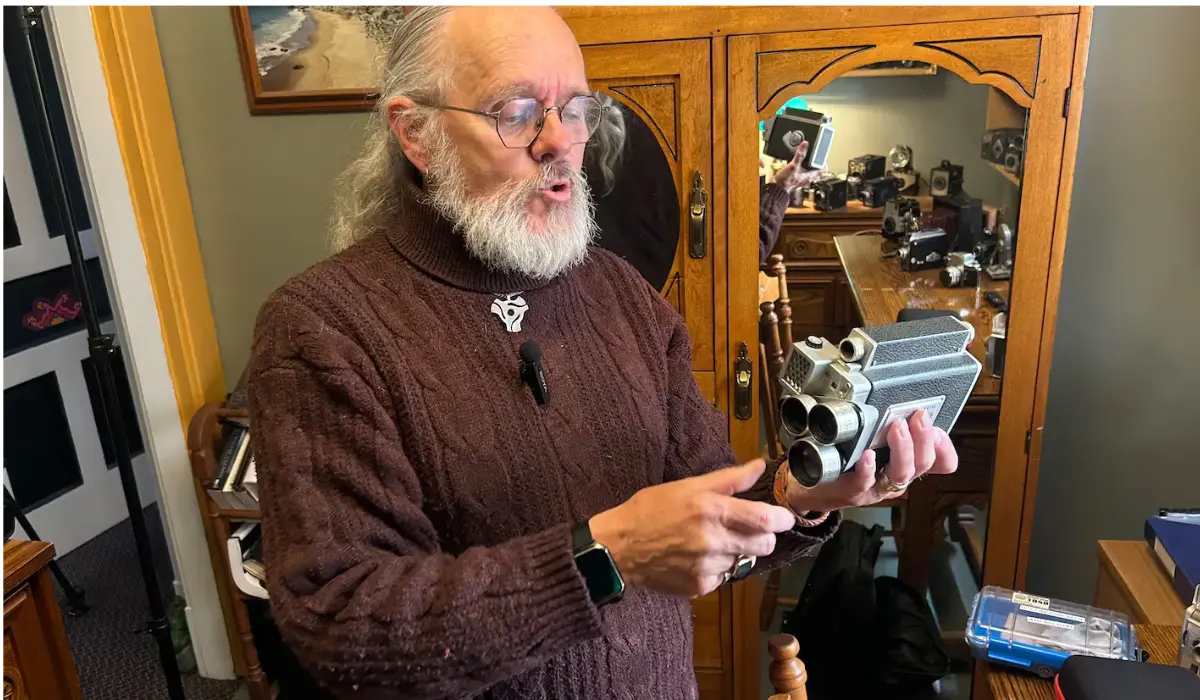
- John Duffy, a resident of Sydney, Nova Scotia, has amassed a historic personal collection of more than 175 vintage cameras built predominantly in the early to mid-20th century.
- Despite their age and reliance on slower mechanical shutter speeds, every single camera in Duffy’s extensive collection remains fully functional.
- The collection features century-old accordion-style expandable bellows cameras dating back to 1901 and 1902, alongside a 1950s camera still housing its original unexposed film and a compact 1960s-style spy camera.
- Duffy estimates he began gathering equipment roughly 45 years ago after taking a high school job at a local camera repair shop where discarded customer gear was saved from being thrown away.
- As he approaches his retirement years, Duffy wishes to donate the collection intact to a museum or educational institution, provided it remains publicly displayed rather than placed in storage boxes.
- Technology analyst Carmi Levy praised the historical value of the repository, describing it as a vital treasure that preserves the tangible evolution of photography.
SYDNEY (Sydney Now Magazine) October 26, 2026 — John Duffy, a resident of Sydney, Nova Scotia, has publicly unveiled a personal repository containing over 175 vintage cameras, reflecting an collecting effort spanning roughly 45 years.The historical collection includes early 20th-century accordion-style bellows models, 1950s units containing original period film, miniaturized spy cameras, and vintage home movie projectors containing 70-year-old family footage.Despite relying on legacy mechanical shutter systems, all 175 pieces in the collection remain fully operational.As he approaches retirement, Duffy intends to donate the entire collection to a museum or academic institution under the condition that it remains permanently displayed intact rather than archived in storage.
- Key Points
- How Did John Duffy Begin Building His 175-Piece Vintage Camera Collection?
- What Rare Historical Artifacts Are Preserved Within the Collection?
- What Are John Duffy’s Requirements for Donating His Historic Camera Repository?
- How Does the Vintage Camera Collection Compare to Modern Digital Photography?
- Background of the Particular Development
- How This Development Can Affect Museum Visitors, Students, and Cultural Institutions
How Did John Duffy Begin Building His 175-Piece Vintage Camera Collection?
As reported by journalist Paul Hollingsworth of CTV News, John Duffy’s lifelong enthusiasm for photography and camera mechanics began in his youth, when he purchased his initial gear and enrolled in introductory photography courses.His passion evolved into a lifelong hobby after he secured employment at a local camera repair shop shortly after finishing high school.
Describing the origins of his collection, John Duffy stated: “Customers would bring old cameras in and see if they were worth getting repaired and if they weren’t, they would say, ‘toss them out’. And they were just too gorgeous to throw them away”.
Rather than allowing the equipment to be discarded, Duffy began preserving the unwanted gear, laying the groundwork for what would become a four-decade collecting endeavor. As reported by Paul Hollingsworth of CTV News, Duffy expanded his inventory by attending regional yard sales, estate auctions, and specialty markets across Atlantic Canada.Reflecting on the growth of his inventory, Duffy noted: “The more I got, the more I got into it and then the more I got really into it”.Duffy estimates that his systematic collecting began approximately 45 years ago.
What Rare Historical Artifacts Are Preserved Within the Collection?
As reported by Paul Hollingsworth of CTV News, Duffy’s collection spans more than a century of optical and mechanical innovation, featuring items that highlight the evolution of analog photography.The vast majority of the 175 units date from the early-to-mid-20th century and feature slower, mechanical shutter speeds that remain in working order.
Among his favorite pieces are several century-old accordion-style expandable bellows cameras, which represent some of the earliest portable consumer formats.Examining his oldest acquisition, John Duffy stated: “I have one from 1901 and the one next to it is from 1902”.
The collection also features specialized and niche photographic equipment from different historical eras.Duffy highlighted a unit from the mid-20th century, stating: “This one is from the 1950s and the original film is still in the camera”.His inventory includes a miniature spy camera modeled after the subminiature devices popularized in 1960s and 1970s cinema.
In addition to still cameras, Duffy maintains four fully operational film projectors containing home movie reels of his parents recorded over 70 years ago.Recalling the workflow of mid-century home filmmaking, Duffy remarked: “In those days you would take your film and send it away and two weeks later you would get the film with movies back”.
What Are John Duffy’s Requirements for Donating His Historic Camera Repository?
As reported by Paul Hollingsworth of CTV News, as John Duffy approaches his retirement years, his primary focus has shifted toward securing a permanent, public home for his extensive collection.Duffy expressed a desire to donate the entire 175-piece assembly to a museum, historical society, or educational institution, but he has established two strict conditions for potential recipients.
First, Duffy requires that the entire collection remain complete and intact as a single archive, rather than being broken up or sold individually.Second, the recipient institution must commit to keeping the cameras on permanent public display.Emphasizing his stance on preserving the visibility of the items, John Duffy stated: “I don’t want to put it in boxes or put it in storage”.
Analyzing the historical and educational significance of the collection, Canadian technology analyst Carmi Levy stated that the repository represents a rare historical resource.As reported by Paul Hollingsworth of CTV News, Carmi Levy stated: “This collection excites me and we need to preserve this history for ourselves to understand how we got to where we are, and why we appreciate all the things we use today… If we don’t, we could lose that sense of history”.
How Does the Vintage Camera Collection Compare to Modern Digital Photography?
As reported by Paul Hollingsworth of CTV News, inspecting his multi-generational collection leads Duffy to reflect on the contrast between mechanical analog photography and contemporary digital technology.
Duffy noted that mid-century analog cameras offered a straightforward, accessible user experience that differs sharply from complex modern digital devices.Comparing older mechanical gear to modern smartphones, John Duffy stated: “These older cameras were much easier and user-friendly. A lot of smartphone cameras today don’t come with a proper manual and it is very hard for someone in my age to buy a phone and figure out all the hidden features… But old cameras back in the day, had a four-page manual and if you read it, you were good to go”.
Duffy emphasized that his collection serves as a physical record of industrial design and optical engineering, describing it as a living timeline that documents how consumer technology evolved over the 20th century.
Background of the Particular Development
The history of consumer photography underwent rapid mechanical and optical transformation throughout the 20th century. In the early 1900s, expandable bellows cameras utilizing folding leather sleeves and glass plates or early roll film allowed photographers to capture high-resolution images outside of formal commercial studios. By the mid-20th century, 35mm film formats, twin-lens reflex designs, and rangefinder mechanisms standardized consumer photography, making personal cameras ubiquitous across household life.
Over the past three decades, the rapid shift from silver-halide film processing to digital sensors and smartphone computational photography caused many traditional camera manufacturers to cease production of mechanical bodies and analog lenses. Consequently, fully operational early-20th-century cameras have become increasingly rare, with many working examples lost to decay, improper storage, or disposal.
In Nova Scotia and across Canada, regional museums and industrial heritage institutions frequently rely on private collectors to preserve historical material culture. Duffy’s 45-year effort to retain discarded repair-shop equipment and restore estate-sale finds mirrors broader international movements among horologists, archivists, and analog photography enthusiasts dedicated to preserving mechanical engineering heritage before the physical knowledge and hardware are lost.
How This Development Can Affect Museum Visitors, Students, and Cultural Institutions
The prospective donation and public display of John Duffy’s 175-piece vintage camera collection carries direct educational, cultural, and operational implications for heritage institutions, photography students, and local museum visitors in Atlantic Canada.
Impact on Museums and Educational Institutions
For regional museums, heritage centers, or photography schools that accept Duffy’s donation conditions, acquiring an intact, 175-piece working collection provides an immediate, low-cost permanent exhibit. Unlike static non-functional artifacts, a fully working collection allows curatorial staff and photography educators to demonstrate mechanical shutter mechanisms, aperture controls, and optical bellows systems to students. This hands-on material context helps design and technology students understand the fundamental physics of light capture and the mechanical lineage that preceded digital sensor design.
Influence on Museum Visitors and Cultural Tourism
For museum visitors, local residents, and maritime tourists, a permanently displayed vintage camera collection offers an engaging historical experience. Older visitors can connect nostalgically with mid-century consumer devices and family movie projection formats, while younger digital-native generations gain insight into the physical labor and technical constraints that defined photography prior to instantaneous digital imagery. If showcased in Nova Scotia, the complete archive could serve as a unique regional cultural attraction, reinforcing the importance of community-led heritage preservation.