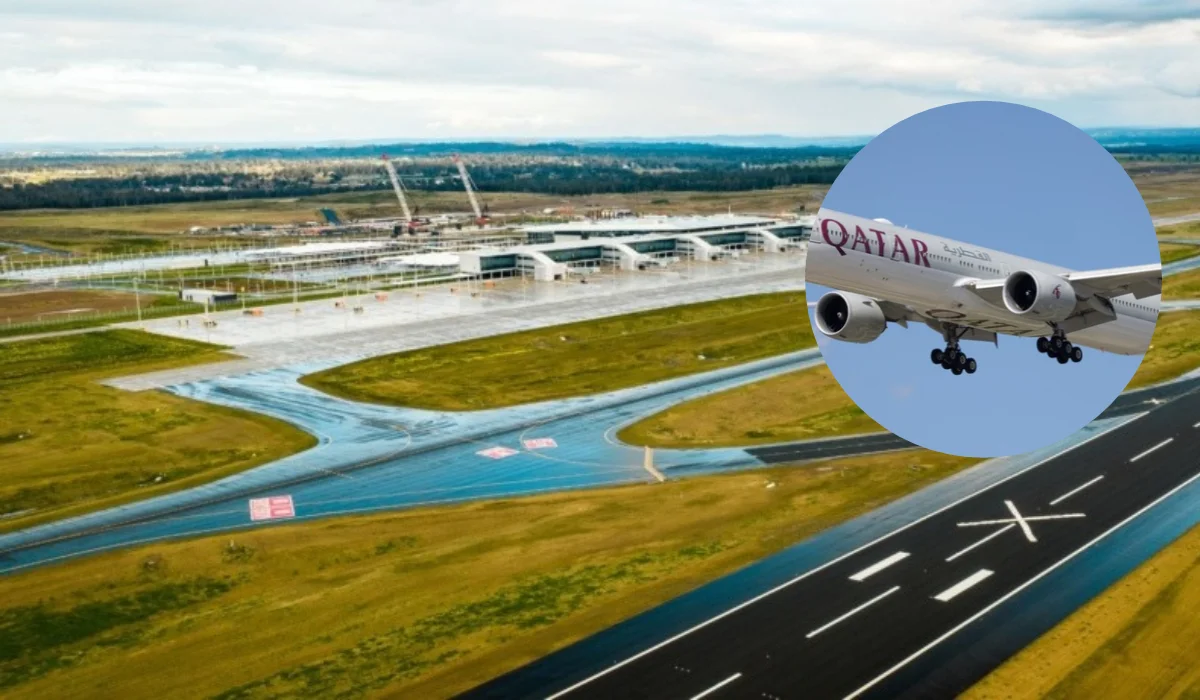
Key Points
- New International Gateway: Qatar Airways has officially announced plans to launch direct long-haul passenger flights connecting Doha’s Hamad International Airport (DOH) with Western Sydney International Airport (WSI) beginning 15 December 2027.
- Initial Frequency and Expansion Target: The state carrier will initially operate three weekly return services using Boeing 777-300ER aircraft, with published plans to progressively scale up operations to a daily frequency.
- Aircraft Configuration and Onboard Amenities: The services will feature 354 total seats across a two-class cabin (42 Business Class Qsuites and 312 Economy Class seats) alongside complimentary high-speed Starlink Wi-Fi for all passengers.
- Curfew-Free Operational Advantage: Operating at Western Sydney International allows Qatar Airways to bypass the strict night-time curfew enforced at Sydney Kingsford Smith Airport (SYD), enabling late-night arrival and departure slots optimized for global hub connections.
- Strengthened Commercial Alliances: The route reinforces Qatar Airways’ expanding partnership with Virgin Australia, following approval from the Australian Competition and Consumer Commission (ACCC) in March 2025 for code-sharing and integrated international flying operations.
SYDNEY (Sydney Now Magazine) October 21, 2026 – Qatar Airways has officially revealed a major expansion of its Australian network, confirming the launch of direct commercial flights between Doha and the newly constructed Western Sydney International Airport starting 15 December 2027. The new route will establish Western Sydney as the airline’s seventh Australian gateway, offering residents in Sydney’s growing western metropolitan corridors direct access to more than 170 global destinations through Hamad International Airport. Operating without night-time curfew restrictions, the service marks a key competitive milestone for the Australian long-haul aviation sector and further solidifies the strategic alliance between Qatar Airways and Virgin Australia.
- What Are the Operational Schedule and Aircraft Details for the New Western Sydney Route?
- How Does Western Sydney International Airport’s Curfew-Free Status Benefit Airlines and Passengers?
- How Does the Launch Impact Qatar Airways’ Partnership with Virgin Australia and Market Competition?
- What Strategic Role Does the Route Play for Regional Travel, Freight, and Tourism?
- Background of the Particular Development
- Prediction: How This Development Can Affect Australian Travellers and Aviation Stakeholders
What Are the Operational Schedule and Aircraft Details for the New Western Sydney Route?
As reported by aviation journalist Nathan Baker of Aviation Business Middle East, Qatar Airways will initially deploy a fleet of Boeing 777-300ER widebody aircraft to service the direct link between Doha and Western Sydney. The long-haul aircraft configuration accommodates up to 354 passengers per flight, structured into 42 premium Business Class seats and 312 standard Economy Class seats.
As detailed in official schedule filings published by Qatar Airways, the route will operate under flight numbers QR906 and QR907:
- Flight QR906 (Doha to Western Sydney): Departs Hamad International Airport (DOH) at 01:40 local time on Mondays, Wednesdays, and Fridays, arriving at Western Sydney International Airport (WSI) at 23:45 local time the same day.
- Flight QR907 (Western Sydney to Doha): Departs Western Sydney International Airport (WSI) at 16:10 local time on Tuesdays, Thursdays, and Saturdays, reaching Doha at 23:00 local time.
As reported by Travel Weekly and Executive Traveller, outbound Business Class passengers will have access to the airline’s Qsuite product, which features fully enclosed private suites. Additionally, all travellers across both cabin classes will receive complimentary access to Starlink high-speed Wi-Fi throughout the flight. While the service launches with three weekly frequencies, airline management confirmed its intention to expand the route to a full daily schedule.
How Does Western Sydney International Airport’s Curfew-Free Status Benefit Airlines and Passengers?
As reported by aviation analysts covering the launch, Western Sydney International Airport (Nancy-Bird Walton Airport) offers structural advantages compared to Sydney Kingsford Smith Airport (SYD). Chief among these advantages is the airport’s ability to support round-the-clock, 24-hour aircraft operations without the imposition of a night-time noise curfew. In contrast, Sydney Kingsford Smith Airport is legally restricted by a strict jet operations curfew enforced between 23:00 and 06:00.
As reported by Dermot Davitt of The Moodie Davitt Report, Western Sydney International Airport Chief Executive Officer Simon Hickey stated that “the timing of the service utilises one of WSI’s key competitive advantages – its 24-hour capacity – which will connect our global city in new and unprecedented ways, increasing choice, flexibility and opportunity, for business, airlines and their customers”.
The late-night arrival slot for flight QR906 at 23:45 would not be legally permissible at Sydney Kingsford Smith Airport. By operating at Western Sydney, Qatar Airways can align its flight schedules directly with its primary hub operations in Doha, allowing return flight QR907 to land in Doha at 23:00, feeding smoothly into an early-morning wave of onward connecting flights across Europe, the United Kingdom, Africa, and the Middle East.
How Does the Launch Impact Qatar Airways’ Partnership with Virgin Australia and Market Competition?
As reported by industry news sources, the new route builds directly upon the commercial alliance between Qatar Airways and Virgin Australia, which received official regulatory authorization from the Australian Competition and Consumer Commission (ACCC) in March 2025. The approved partnership permits Virgin Australia to place its airline code on international services operated by Qatar Airways, providing Virgin loyalty members with status credit accrual and seamless connectivity into Europe and the Middle East.
Under the established wet-lease and code-share framework, the alliance encompasses 28 weekly return flight frequencies across major Australian gateways, including Sydney, Melbourne, Brisbane, and Perth. The addition of Western Sydney as a seventh Australian destination extends the geographic operational footprint of the alliance.
As noted in regional antitrust reviews by the ACCC, the integrated arrangement is designed to inject heightened competition into Australia’s international aviation sector, which has historically been dominated by Qantas and its long-standing international partnership with Emirates. While regulatory authorities determined the arrangement would stimulate route competition across Australia–Middle East corridors, industry analysts observe that passenger airfares will ultimately continue to fluctuate based on broader market demand and prevailing fuel and operational expenses.
What Strategic Role Does the Route Play for Regional Travel, Freight, and Tourism?
As reported by aviation analysts at IndexBox, Qatar Airways Group Chief Executive Officer Hamad Al Khater described the expansion into Western Sydney as a significant strategic step in the airline’s commitment to Australia. Al Khater noted that the direct connection with Doha’s Hamad International Airport links Western Sydney directly to over 170 international destinations, opening fresh avenues for international business, trade, tourism, and bilateral investment.
The introduction of direct international service provides localized convenience for the population residing in Western Sydney. Passengers living in the western suburbs will no longer need to travel across the broader Sydney metropolitan area to access long-haul international flights at Kingsford Smith Airport.
Beyond passenger traffic, the Boeing 777-300ER aircraft deployment provides substantial belly-hold cargo capacity, enabling Australian exporters to transport fresh agricultural goods, perishable produce, and commercial freight directly into Middle Eastern and European markets via Qatar Airways’ global cargo network.
Background of the Particular Development
The expansion of Qatar Airways services into Western Sydney follows significant regulatory and policy shifts within Australia’s civil aviation framework. In July 2023, the Australian Federal Government rejected a formal application by Qatar Airways to add 28 additional weekly flights to major Australian capital city airports, citing national interest considerations. That decision effectively constrained the airline’s expansion in primary Australian gateways for nearly three years.
However, earlier in 2026, Australian Federal Transport Minister Catherine King oversaw an updated bilateral air services agreement between Australia and the State of Qatar. Under the revised bilateral terms, Qatar was granted approval for up to 35 weekly passenger flights into Australia, including seven dedicated weekly frequencies specifically allocated to Western Sydney International Airport. The initial three-weekly schedule announced for December 2027 utilizes a portion of this newly granted traffic entitlement, with the planned move to daily flights in 2028 slated to absorb the full quota of seven weekly flights permitted under the updated bilateral accord.
Prediction: How This Development Can Affect Australian Travellers and Aviation Stakeholders
The launch of Qatar Airways services at Western Sydney International Airport will trigger distinct developments across multiple sectors of Australia’s travel and aviation ecosystem:
- For Western Sydney Residents and Outbound Travellers: Passengers living in Greater Western Sydney will experience a substantial reduction in transit times, bypassing the congested transit corridors leading to Kingsford Smith Airport. The availability of direct long-haul flights with full Starlink Wi-Fi and Qsuite options will elevate the local travel experience and provide increased schedule flexibility for international journeys.
- For Incumbent Australian Airlines and Competitors: The introduction of a major Middle Eastern carrier operating out of Western Sydney will intensify competitive pressure on Qantas, Jetstar, and rival international airlines. Competitors may be forced to adjust their pricing structures, loyalty offerings, or international flight schedules to retain market share across North American, European, and Middle Eastern flight corridors.
- For Local Western Sydney Businesses, Hotels, and Exporters: The arrival of long-haul international flights will stimulate local economic development across Sydney’s west. Local hospitality operators, hotels, and transport services stand to gain from incoming international visitors, while regional exporters will benefit from reliable, year-round air freight capacity directly into global supply chains.