- Western Sydney University (WSU) researchers have been awarded more than $12.5 million by the NSW Environmental Trust to spearhead the Ecosystem Diversity and Climate Adaptation Trials across New South Wales.
- The funding represents the largest single research grant awarded to Western Sydney University over the past ten years.
- The eight-year initiative will run from 2026 to 2034 and will be operated out of the University’s Hawkesbury Institute for the Environment (HIE).
- The project focuses on restoring critically degraded grassy woodland ecosystems across south-eastern Australia, featuring open eucalypt canopies and rich understory vegetation.
- Led by Chief Investigator Associate Professor Paul Rymer, the interdisciplinary team integrates expertise from biology, business, computer science, and the arts.
- Key deliverables include generating climate-ready seed stocks for iconic eucalypts, wattles, and ground cover, establishing long-term planting trials, and creating a digital ‘knowledge commons’ web platform.
- The project establishes multi-sector partnerships across universities, government bodies, industry, Landcare groups, regional communities, and Aboriginal organizations.
- Funding is anchored by the NSW Environmental Trust’s updated strategy prioritizing long-term environmental restoration, river health, climate adaptation, and Aboriginal-led natural resource management.
Sydney (Sydney Now Magazine) November 10, 2026 – Western Sydney University has been awarded a landmark $12.5 million grant by the NSW Environmental Trust to lead a major eight-year climate adaptation and ecosystem restoration project across New South Wales. Operating from 2026 to 2034, the Ecosystem Diversity and Climate Adaptation Trials initiative will be directed by the university’s Hawkesbury Institute for the Environment to safeguard degraded grassy woodlands. The multi-disciplinary program brings together academic, industry, government, Landcare, and Aboriginal partners to produce climate-resilient seed stocks and web-based decision tools for land managers. Representing the university’s largest research grant in a decade, the project aims to build self-sustaining ecosystems capable of surviving escalating climate pressures while securing long-term environmental, social, and economic benefits.
- What Are the Main Goals of the Ecosystem Diversity and Climate Adaptation Trials?
- How Will Interdisciplinary Research Support Landscape Restoration?
- Why Is the NSW Environmental Trust Funding This Eight-Year Initiative?
- Background of the Particular Development After the News
- How This Development Can Affect Farmers, Land Managers, and Regional Communities
As reported by university news correspondents and environmental science journalists covering Australian ecological research, Western Sydney University (WSU) has secured over $12.5 million from the NSW Environmental Trust. The substantial allocation will fund an extensive, multi-year research program designed to provide experimental evidence, infrastructure, and decision-support mechanisms to facilitate the climate-informed restoration of grassy woodland environments across New South Wales.
The project, titled the Ecosystem Diversity and Climate Adaptation Trials, marks the largest single research grant awarded to Western Sydney University within the past decade. Operations will be anchored at the university’s Hawkesbury Institute for the Environment (HIE), a globally recognized center for terrestrial ecology and climate change research. The ecological focus centers specifically on the iconic grassy woodlands of south-eastern Australia—vital landscapes characterized by open eucalypt canopies and highly diverse understory plants that have suffered extensive historical clearing, fragmentation, and land degradation.
Stressing the scientific necessity and collaborative framework of the trial, Chief Investigator Associate Professor Paul Rymer of the Hawkesbury Institute for the Environment stated that “There is an urgent need to develop robust approaches to ecosystem restoration to ensure their long-term viability, the biodiversity they support and the services they provide, including cultural connections”.
Detailing how the initiative plans to bridge the gap between academic trial data and practical land management application, Associate Professor Rymer added that “The outcomes will be translated using dedicated funds for communications and tools developed for uptake by policy makers and land managers to improve the success of nature-based solutions under climate change”.
According to media releases provided by Western Sydney University, the broad research cohort led by Associate Professor Paul Rymer includes HIE researchers Professor Mark Tjoelker, Professor Rachael Gallagher, Professor Uffe Nielsen, Distinguished Professor Belinda Medlyn, and Dr Laura Williams. Reflecting an interdisciplinary approach, the team is further supported by Associate Professor Neil Perry from the WSU School of Business, Dr Yi Guo and Dr Hao Wu from the School of Computer, Data and Mathematical Sciences, and Dr Kate Richards from the School of Arts.
Commending the research group on securing the landmark funding award, Vice-Chancellor and President of Western Sydney University, Distinguished Professor George Williams AO, stated that “This flagship research project demonstrates the power of interdisciplinary research at Western Sydney University in supporting climate resilience into the future. We’re proud that Associate Professor Rymer and his team, together with their collaborators and partners, will lead this critical adaptation trials project with significant support from the NSW Environmental Trust”.
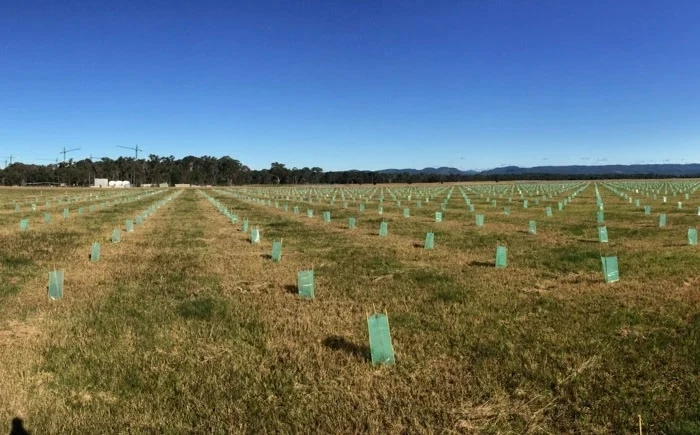
Fieldwork and methodology will involve comprehensive surveys of remnant vegetation across south-eastern Australia to collect seeds with high genetic diversity, helping scientists model species climate adaptation and environmental vulnerability. Researchers will conduct controlled planting trials to evaluate species performance, carbon sequestration potential, habitat creation, and pollination support under alternative provenancing strategies. The overarching operational goal is to cultivate self-sustaining plant populations capable of yielding a scalable supply of climate-ready seed for iconic eucalypt trees, wattles, and ground cover species.
Additionally, the project team will leverage National Collaborative Research Infrastructure Strategy (NCRIS) facilities and develop a digital ‘knowledge commons’. This web platform will offer accessible tools for farmers, policy makers, and conservation groups to accurately evaluate the costs, co-benefits, and long-term outcomes of different restoration models. The adaptation trial sites will be protected under conservation agreements, ensuring ongoing environmental, social, and economic returns for regional communities, Landcare groups, and Aboriginal custodians.
What Are the Main Goals of the Ecosystem Diversity and Climate Adaptation Trials?
The eight-year project established by Western Sydney University addresses systemic environmental threats facing rural and regional New South Wales:
- Production of Climate-Ready Seed: Gathering diverse genetic material from remnant vegetation across south-eastern Australia to breed eucalypt, wattle, and ground cover seeds adapted to rising temperatures and shifting rainfall patterns.
- Restoration of Grassy Woodlands: Rebuilding degraded grassy woodland ecosystems to restore essential biodiversity, soil health, and natural pollination processes.
- Creation of a Digital ‘Knowledge Commons’: Building an accessible online platform featuring web tools that allow land managers and policy makers to measure financial costs, carbon sequestration potential, and ecological co-benefits of varied planting strategies.
- Long-Term Land Conservation: Securing formal conservation agreements for trial sites to guarantee continuous environmental, social, and cultural benefits for local Landcare and Aboriginal groups.
How Will Interdisciplinary Research Support Landscape Restoration?
The project’s research structure integrates multiple academic disciplines to ensure ecological data is effectively translated into real-world business and social applications:
- Terrestrial Ecology and Biology (HIE): Leads fieldwork, seed collection, genetic modeling, and plant survival trials under changing climate parameters.
- Business and Economics (School of Business): Assesses the cost-effectiveness, financial co-benefits, and economic viability of alternative restoration models for private and public landowners.
- Computer Science and Data Analytics (School of Computer, Data and Mathematical Sciences): Constructs the web architecture and data algorithms underpinning the interactive ‘knowledge commons’ decision tools.
- Arts and Social Communications (School of Arts): Focuses on community engagement, clear science communication, and maintaining cultural connections to Country in collaboration with Indigenous partners.
Why Is the NSW Environmental Trust Funding This Eight-Year Initiative?
The $12.5 million grant aligns directly with a refreshed strategic agenda adopted by the NSW Environmental Trust. The funding body has shifted its grant distribution framework to prioritize long-term, large-scale projects that deliver tangible, evidence-based solutions to systemic environmental challenges.
By committing sustained funding from 2026 through 2034, the Trust is supporting targeted priorities including native biodiversity conservation, active climate adaptation, river and catchment health, ecosystem restoration, and Aboriginal-led natural resource management. The extended eight-year timeline allows researchers to monitor plant growth rates and ecological resilience across multiple seasonal cycles, producing robust datasets that short-term funding grants cannot provide.
Background of the Particular Development After the News
Grassy woodlands in south-eastern Australia represent some of the most threatened ecological communities in the nation. Following European settlement, extensive agricultural expansion, land clearing, and livestock grazing led to the removal of more than 90 percent of original grassy woodland cover across the sheep-wheat belt of New South Wales. The remaining patches exist primarily as fragmented remnants along road reserves, Travelling Stock Reserves, and isolated private farm plots.
Over recent decades, climate change has compounded historical land clearing. Intensifying drought cycles, higher mean temperatures, and unseasonal heatwaves have caused severe dieback among mature eucalypt species and eroded understory biodiversity. Traditional ecosystem restoration techniques—which relied on sourcing local seeds from immediately adjacent areas—have increasingly failed because local plant populations lack the genetic capacity to cope with rapidly shifting climatic conditions.
The establishment of the Ecosystem Diversity and Climate Adaptation Trials builds on years of foundational research conducted by WSU’s Hawkesbury Institute for the Environment. By shifting toward “climate-adjusted provenancing”—sourcing seeds from warmer or drier geographic regions—researchers aim to future-proof native flora. The new $12.5 million investment by the NSW Environmental Trust provides the capital required to scale these experimental concepts into landscape-wide restoration frameworks across New South Wales.
How This Development Can Affect Farmers, Land Managers, and Regional Communities
The rollout of the $12.5 million adaptation trial project over the next eight years will have widespread, direct effects across regional New South Wales:
1. Land Managers, Farmers, and Agriculture
For agricultural landowners and primary producers, the initiative will remove much of the financial and practical guesswork associated with environmental planting. Access to the digital ‘knowledge commons’ platform will allow farmers to select seed mixes tailored to survive future regional climate shifts while calculating precise co-benefits, such as carbon credits, shade for livestock, and windbreak protection. Reliable access to climate-ready seeds will significantly increase the survival rate of farm revegetation projects, protecting land care investments.
2. Aboriginal Groups and Regional Communities
Local Aboriginal communities and Landcare networks stand to gain direct economic, social, and cultural opportunities. Because the project emphasizes co-design and formal conservation agreements, Aboriginal-led natural resource management groups will participate directly in seed harvesting, trial monitoring, and traditional land management integration. Regional communities will benefit from localized economic activity created by long-term trial infrastructure alongside healthier local ecosystems that preserve natural heritage and river health.
3. Policy Makers and the Commercial Restoration Sector
For government bodies and commercial seed suppliers, the project will establish standardized benchmarks for climate-informed ecological restoration. Policy makers will gain clear, empirical evidence to update environmental regulation and biodiversity offset schemes. Simultaneously, commercial nurseries and seed collectors will receive clear guidelines on provenancing, establishing a market pipeline for climate-resilient native seed stocks across south-eastern Australia.